MikroTik vs TP-Link: Which Router Is Better for Your Business?
In today’s connected business environment, choosing the right networking equipment is essential for maintaining productivity, security, and seamless communication. Whether you manage a small office, a retail store, a warehouse, or a growing enterprise, your router serves as the backbone of your network. Among the most trusted networking brands in the market, MikroTik and TP-Link stand out for their reliability, advanced features, and wide range of business networking solutions. But which router is the better choice for your business?
The answer depends on your organization’s size, technical requirements, budget, and long-term networking goals. In this guide, we’ll compare MikroTik and TP-Link routers to help you make an informed decision.
Understanding Business Networking Requirements
Before comparing the two brands, it’s important to understand that every business has unique networking needs. A small office with a handful of users may only require reliable internet connectivity and secure Wi-Fi, while a large enterprise may need advanced routing, VLANs, VPN connectivity, bandwidth management, multiple WAN connections, and centralized network administration.
Selecting a router isn’t simply about choosing the fastest device. It’s about investing in a solution that delivers stability, security, scalability, and performance while supporting your business as it grows.
MikroTik Routers: Built for Advanced Networking
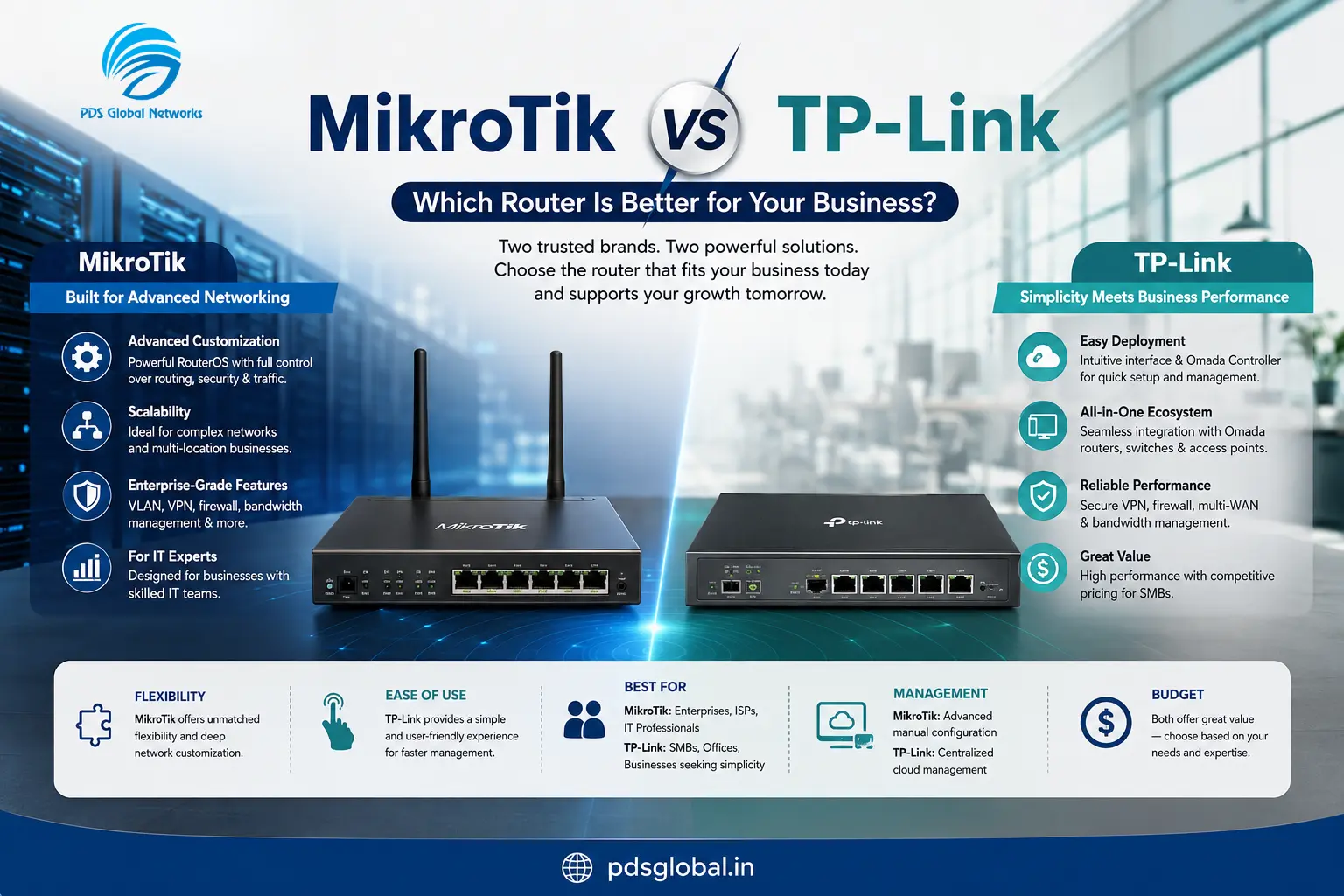
MikroTik has earned a strong reputation among IT professionals, Internet Service Providers (ISPs), and enterprise network administrators. Powered by its proprietary RouterOS, MikroTik routers offer extensive configuration options and advanced networking capabilities that are typically found in much more expensive enterprise solutions.
Businesses that require features such as VLAN configuration, dynamic routing protocols, VPN servers, firewall customization, bandwidth management, load balancing, and advanced network monitoring often prefer MikroTik. RouterOS gives administrators exceptional control over every aspect of the network, making it an excellent choice for organizations with experienced IT teams.
Another significant advantage is scalability. As your network expands, MikroTik routers can accommodate increasingly complex environments without requiring a complete infrastructure replacement. Their flexibility makes them particularly suitable for educational institutions, hospitality businesses, manufacturing facilities, warehouses, and service providers managing multiple locations.
However, its powerful capabilities come with a learning curve. Businesses without dedicated IT professionals may find the extensive configuration options challenging during initial deployment.
TP-Link Routers: Simplicity Meets Business Performance
TP-Link has become one of the world’s leading networking manufacturers by offering reliable, user-friendly products suitable for businesses of all sizes. Its business-focused Omada ecosystem combines routers, managed switches, wireless access points, and centralized cloud management into a unified networking platform.
One of TP-Link’s greatest strengths is ease of deployment. Businesses can configure routers quickly through an intuitive web interface or the Omada Controller, making network management straightforward even for organizations with limited technical expertise.
Its routers also deliver excellent performance for small and medium-sized businesses by supporting secure VPN connections, firewall protection, multiple WAN connectivity, bandwidth management, and seamless integration with wireless access points and PoE switches. Organizations looking for dependable networking without the complexity of enterprise-grade configuration often find TP-Link to be the ideal solution.
Additionally, their products are well known for offering outstanding value, combining reliable performance with competitive pricing that suits businesses working within budget constraints.
MikroTik vs TP-Link: Key Differences
While both brands provide dependable networking solutions, they are designed with different users in mind.
MikroTik focuses on flexibility and advanced customization. Its RouterOS platform gives administrators complete control over routing, security, traffic management, and network optimization. This makes it an excellent option for organizations requiring highly customized network configurations or complex enterprise environments.
TP-Link, on the other hand, emphasizes simplicity, ease of management, and integrated networking solutions. The Omada ecosystem enables centralized management of routers, switches, and wireless access points from a single dashboard, reducing administrative complexity while maintaining excellent performance.
For businesses seeking straightforward deployment with minimal maintenance, TP-Link often provides a faster implementation process. Organizations requiring advanced routing capabilities and granular network control may benefit more from MikroTik.
Which Router Is Better for Your Business?
The best choice depends entirely on your business requirements.
If your organization has experienced IT personnel and requires advanced routing protocols, custom firewall rules, VPN configurations, multiple ISP connections, or sophisticated traffic management, MikroTik offers exceptional flexibility and long-term scalability.
Alternatively, if your priority is deploying a secure, reliable, and easily managed network for an office, retail business, healthcare facility, educational institution, or hospitality environment, TP-Link provides an excellent balance between performance, simplicity, and affordability.
Many growing businesses also appreciate TP-Link’s Omada ecosystem because it allows routers, switches, and wireless access points to work together under centralized cloud management, simplifying day-to-day network administration.
Choosing the Right Networking Solution
Rather than asking which brand is universally better, businesses should ask which solution best aligns with their operational goals.
MikroTik excels in environments where customization, technical control, and advanced networking are priorities. TP-Link excels in environments where simplicity, centralized management, and cost-effective deployment are equally important.
Both manufacturers continue to innovate and deliver reliable networking products trusted by businesses worldwide. The right decision depends on your current infrastructure, technical expertise, expected network growth, and budget.
Why Choose PDS Global Networks?
At PDS Global Networks, we understand that every business has different networking requirements. Our experienced team helps organizations choose the most suitable networking solutions based on performance, scalability, security, and long-term value.
We offer a comprehensive range of MikroTik and TP-Link networking products, including business routers, managed switches, wireless access points, PoE solutions, fiber networking products, and enterprise connectivity solutions. Whether you’re upgrading an existing network or building a new IT infrastructure, our experts can recommend the right products to meet your business objectives.